
Why Portuguese Speakers Find Korean Pronunciation Easier Than You Think
When you first hear Korean, especially “Hangul” the Korean alphabet it can sound mysterious to a Portuguese speaker.
But here’s the truth I’ve noticed from talking to Brazilian and other Portuguese-speaking learners: Korean pronunciation isn’t as impossible as it seems and in some ways, your background actually gives you an advantage others might not expect.
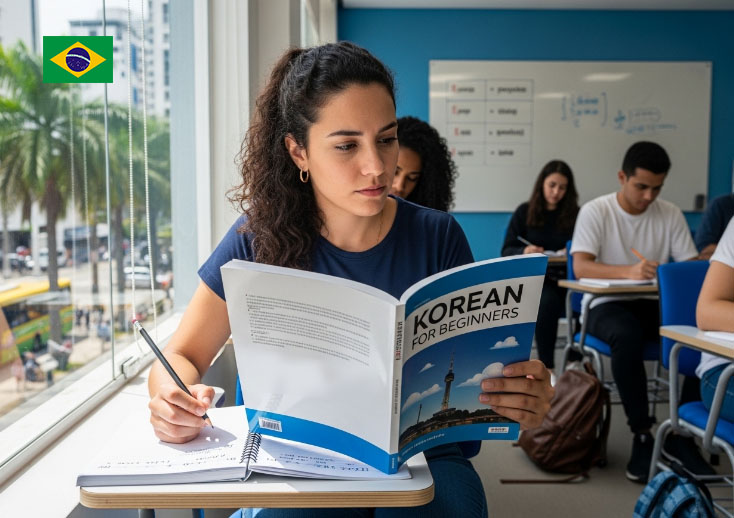
Korean phonetics might look unfamiliar at first, but once you understand how Hangul works as a logical, phonetic system and how sounds map to your native Portuguese, you’ll see patterns that make pronunciation easier than many learners assume.
Let’s break down how this works in real terms no drama, just real insight from someone who’s watched thousands of learners progress from “I can’t even say this!” to confident “annyeonghaseyo!”
Hangul: A Phonetic Script That Levels the Playing Field
One of the biggest reasons Portuguese speakers can get a head start is Hangul itself. Unlike Portuguese, where spelling and pronunciation can sometimes drift apart, Korean Hangul is a purely phonetic alphabet.
That means once you learn how each letter sounds, you always know how to pronounce it consistently there are no unpredictable spellings.
This is huge. Portuguese learners who master the Hangul characters notice that:
- Korean vowels are consistent and predictable
- Each letter has a clear, single pronunciation in most contexts
- You don’t have to guess your way like you would with French or English spellings
This straightforward mapping makes the reading process feel less like memorization and more like decoding, especially once you learn the basic structure of syllables.
Vowels and Consonants: Familiar Territory for Portuguese Speakers
While Korean has some sounds that don’t exist in Portuguese, many basic Korean vowels are similar to sounds you already know. For example, Korean vowels like 아 (a), 오 (o), 이 (i), and 우 (u) are close to Portuguese vowel sounds you’re already comfortable with.
This shared vocalic foundation gives Portuguese speakers an initial edge over learners whose native languages lack these vowel qualities.
Of course, some Korean consonants like the difference between ㅂ (b/p) and ㅃ (pp), or ㄱ (g/k) and ㄲ (kk) might take a little practice.
But because Portuguese has clear distinctions between voiceless and voiced consonants, your ear and tongue are already used to subtle articulatory differences, which helps when you train them for Korean contrasts. And remember once you see a Korean letter, you can always pronounce it correctly with practice. That predictability matters.
Hangul’s Rhythm Matches Portuguese Syllable Logic
Here’s an insight many learners don’t realize at first: Hangul syllables are built block by block each block always contains a vowel, and usually consonants around it.
This consistent syllabic structure mirrors how Portuguese combines vowels and consonants not in messy clusters, but in reliable patterns.
In practice, this means a Brazilian student can read Korean out loud accurately within just a few days of learning Hangul because your brain is already used to breaking words into clear, predictable units rather than guessing based on inconsistent spelling rules.
Common Korean Pronunciation Traps – and Why They’re Not That Bad
Even though Hangul is logical, foreign learners often hit a few bumps on the road. Reddit threads from actual learners show that certain sounds like the Korean consonant cluster ㄲ or the nasal endings like ㅇ and ㄴ can take time to produce accurately. These are subtleties rather than barriers.
For example:
Korean distinguishing 오 (o) vs 우 (u) might feel subtle at first, but once you hear each sound in context, your Portuguese-trained ear can begin to pick up on the difference.
Some consonant clusters that look tricky are actually just phonetic combinations your mouth can learn step by step.
Here’s the key: these are not dead ends they’re just patterns you’ll internalize with hearing and repetition, and that’s exactly where Portuguese speakers’ strong oral language experience helps.
Recording and Mimicry Works – Portuguese Intuition Helps
One reason Portuguese speakers often improve quickly with Korean pronunciation is this: Portuguese itself is a highly phonetic, expressive language. You’re already used to listening to sounds and reproducing them with clarity vowels, consonants, rhythm all that practice from your native language does transfer.
In Korean, that means:
- You’re already sensitive to vowel quality, which helps with Korean vowels that are subtle but consistent.
- You’re used to clear, strong enunciation helpful for distinguishing precise consonants like ㄷ vs ㅌ, ㅈ vs ㅊ.
- You can practice syllable timing in Korean with confidence because Portuguese speech patterns train your ear well.
Language learning isn’t just memorizing words it’s training your listening and speaking muscles, and Portuguese speakers are already strong in that department.
Practical Tips for Portuguese Speakers Mastering Korean Pronunciation
Here’s how you can accelerate your progress:
1. Start with Hangul first, not phrases
Hangul’s phonetic map lets you read all Korean words once you know the letters so learn that first and everything becomes faster.
2. Listen and repeat with real Korean audio
Watching Korean dramas, talk shows, or YouTube pronunciation guides helps you internalize the sounds more than memorizing vocabulary alone.
3. Record yourself and compare
This is a trick many Portuguese learners use: record yourself saying Korean syllables and compare them to native speakers. You’ll hear your improvement more clearly than you think.
4. Focus on rhythm and cadence
Korean has a different flow compared to Portuguese, and practicing that rhythm helps you sound more natural quickly.