
Why Kumoh National Institute of Technology is Famous for Engineering Jobs
If you are a student aiming for a powerhouse career in electronics, mechanical systems, or IT in 2026, you need to know about Kumoh National Institute of Technology (KIT).
As a global expert who has seen countless students struggle to find jobs in Seoul, I can tell you that the real action is happening in Gumi. KIT is not just a university; it is a specialized engineering engine located in the heart of South Korea’s largest inland industrial complex.
In 2026, KIT is widely recognized as the top choice for students who want a direct pipeline into Korea’s biggest tech firms.
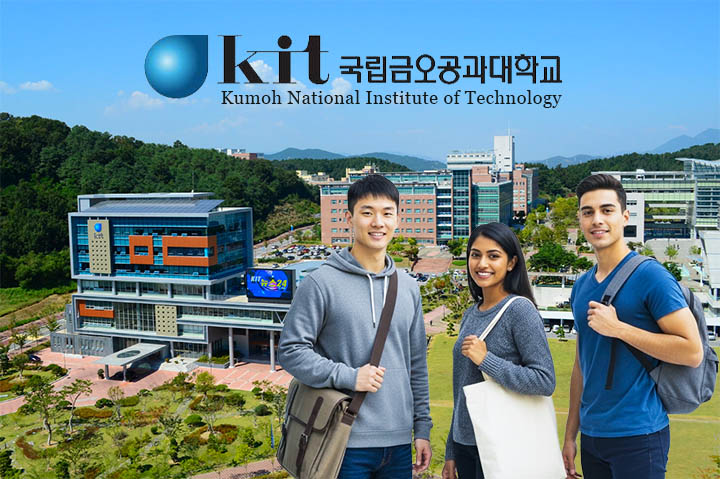
The Gumi Industrial Complex: Your 3,000-Company Network
In 2026, the biggest “unfair advantage” of KIT is its backyard. The university is surrounded by the Gumi Industrial Complex, which houses over 3,000 companies, including global giants like Samsung Electronics, LG Display, and SK Siltron.
This isn’t just about proximity; it’s about integration. KIT has established a “Customized Talent” model where the curriculum is literally designed in collaboration with these companies.
For an international student, this means your senior projects or internships aren’t just academic exercises they are often real-world problems assigned by engineers from the neighboring factories. In 2026, KIT graduates are mostly recruited right within the Gumi area, making it the most “employment-ready” campus in the country.
Specialized Engineering Tracks for the 4th Industrial Revolution
While other schools try to teach everything, KIT focuses on being the best at what matters in 2026: Electronic Engineering, Smart Mobility, and AI Convergence.
The university’s School of Electronic Engineering is legendary in Korea, producing the high-level technicians needed for IoT, robotics, and drone technology. In 2026, they have expanded their “Smart Mobility” and “Artificial Intelligence” departments to meet the global demand for electric vehicle and autonomous driving experts.
If you study at KIT, you are learning the specific hardware and software skills that Korean HR managers are desperately looking for right now.
The K-GKS and KIT International Scholarships
In 2026, the financial barrier to becoming a top-tier engineer has been dismantled at KIT. The university is a key player in the K-GKS (Regional University Track), which offers a full-ride scholarship.
For the 2026 cycle, KIT’s GKS program provides 100 percent tuition coverage, a monthly stipend (approx. 1,130,000 to 1,200,000 KRW for graduates), and even settlement allowances.
Even if you don’t get the GKS, the KIT Internal Scholarships for international students are incredibly generous. Since it is a national university, the base tuition is already low roughly 2,100,000 to 2,400,000 KRW per semester and most international students receive a 30 to 70 percent waiver just by maintaining a decent GPA. In 2026, KIT is the most cost-effective way to get a premium STEM degree in Korea.
Research Output and Patents: The Proof is in the Data
KIT consistently ranks as one of Korea’s leading science and technology universities in terms of research output and patents. In 2026, the university produces over 1,000 high-level research articles annually.
For a graduate student, this means you are working in labs that are actually contributing to the global tech scene. Whether it’s 1D-CNN models for medical diagnostics or advancements in semiconductor materials, the research at KIT is applied innovation.
When you put “KIT Researcher” on your resume in 2026, companies know you have been trained in a high-intensity, practical research environment that values results over theory.
Career Support and the E-7 Visa Pathway
One of the biggest hurdles for foreigners in Korea is the visa. In 2026, KIT’s International Office and Career Center have a specialized “Job Matching Service” that connects foreign graduates with Gumi-based firms willing to sponsor the E-7 (Professional Employment) Visa.
The university hosts regular job fairs specifically for international STEM students. Because the local Gumi industry is so tech-heavy, they are much more open to hiring international engineers who can help them expand globally.
In 2026, graduating from KIT doesn’t just give you a degree; it gives you a legal and professional pathway to stay and work in Korea’s most important industrial hub.
Low Cost of Living: More Money in Your Pocket
Finally, let’s talk about the quality of life in 2026. Gumi is a city built for workers and students. The cost of living is significantly lower than in Seoul or even Busan.
A modern “One-room” near KIT costs about 300,000 to 450,000 KRW per month, and the university’s dormitories are among the best-equipped in the region.
This means that your scholarship or part-time job money goes a lot further. You can live a high-tech lifestyle fast internet, great food, and easy transportation without the financial stress of the capital.
Final Expert Advice: Why Choose KIT in 2026?
If you want to be an engineer who actually builds things and gets hired to do it, KIT is your best bet in 2026. My advice is to focus on your technical portfolio and get at least TOPIK Level 3 to communicate with the local Gumi engineers.
The “Gumi Advantage” is real. While the rest of the world is talking about the future of tech, the people at Kumoh National Institute of Technology are actually making it happen. Apply to KIT in 2026, secure your scholarship, and prepare to join the ranks of the engineers who run the Korean economy.