
Nursing Assistant Visa E-7-S: Your Professional Path in 2026
If you are an international student in Korea in 2026, you probably know that the visa landscape is changing faster than ever. For years, being a nursing assistant was seen as a “part-time” or “temporary” job for foreigners.
But as a global consultant living here, I can tell you that those days are gone. In 2026, the South Korean government has officially classified caregiving and nursing assistance as a “Specific Activity” under the E-7 visa umbrella.
Whether you are looking at the E-7-2 (Semi-Professional) or the E-7-S (Points-based Selective) track, this is now a legitimate, long-term career path. Here is the unfiltered truth on how to secure your professional status in the Korean healthcare system this year.
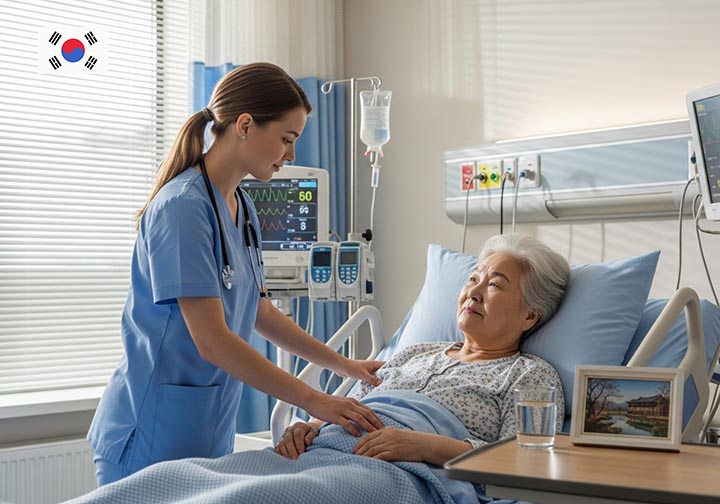
E-7-2 vs E-7-S: Choosing the Right Lane for 2026
In 2026, the terminology can be confusing. Most nursing assistants (Kan-ho-jo-mu-sa) fall under the E-7-2 (Semi-Professional) category, specifically the “Caregiver” sub-type. This visa is tied directly to your employment contract with a nursing home or hospital.
However, the E-7-S (Specialized Talent) visa is the new “gold standard” for 2026. This is a points-based visa that gives you more freedom.
If you have a high TOPIK score, a degree from a Korean university, and a solid salary contract, the E-7-S allows you to stay in Korea with much easier renewal processes.
In my counseling sessions, I always recommend aiming for the E-7-S if you have a Bachelor’s degree, as it acts as a “Fast Track” toward permanent residency (F-5) later on.
The 2026 Salary Standard: Meeting the GNI Requirement
Let’s talk about the money, because this is where most visa applications fail. For any E-7 category in 2026, the Ministry of Justice has strict annual salary requirements based on the Gross National Income (GNI).
For the E-7-2 (Semi-Professional) track, as of February 2026, your annual salary must generally meet at least 80 percent of the previous year’s GNI.
However, for specialized caregiver roles in regional areas, the government has introduced “Eased Standards” to help hospitals hire foreign talent.
In 2026, the minimum salary for a nursing assistant on an E-7-2 visa usually hovers around 30,000,000 KRW to 32,000,000 KRW. As an expert, I advise you to ensure your contract clearly states a monthly salary that meets these legal thresholds before you sign anything.
Educational Requirements: The 2026 Pilot Programs
In 2026, the government designated 24 universities nationwide as “Foreign Caregiver Training Centers.” This is a game-changer.
If you graduate from one of these specialized programs with at least an Associate Degree (전문학사), the usual 1-year work experience requirement is waived.
You can jump straight from your D-2 student visa to an E-7 visa. In 2026, these programs even integrate the 320 hours of mandatory caregiver training into the university curriculum, so you don’t have to attend a separate private academy.
If you are a current student, check if your university is on this list it is the easiest way to secure your future in Korea.
The Point System: How to Win the E-7-S Game
If you are going for the E-7-S Points-based Visa, you need to score at least 80 points out of 125. In 2026, the point distribution has been adjusted to favor younger, Korean-speaking graduates.
Your age (up to 25 points), your degree (up to 35 points), and your TOPIK level (up to 20 points) are the core pillars. In 2026, the government added “Bonus Points” for students who work in “Population Declining Areas” (Regional Cities).
If your hospital is in a place like Jeonju, Gyeongju, or Gunsan, you can get an extra 10 points just for being there. This is why I always tell my clients to look south your visa is much more secure when you are helping a region that actually needs you.
The National Certification: Non-Negotiable in 2026
You cannot get an E-7-2 or E-7-S as a nursing assistant without the National Caregiver Certificate. In 2026, the exam is more accessible, but still rigorous.
You must complete the required training hours and pass a written and practical exam conducted by the Korea Health Personnel Licensing Examination Board.
The 2026 update now allows international students on D-2 or D-10 visas to take this training legally. My advice? Don’t wait until you graduate. Start your training in your senior year so that the moment you have your diploma, you also have your license and can apply for the visa change immediately.
Final Expert Advice: Stay Ahead of the Quota
In 2026, there are “Quotas” for how many E-7-2 visas a single hospital can sponsor (usually 20 percent of their total Korean staff). Before you fall in love with a workplace, ask them: “Do you have a remaining quota for E-7 visa sponsorship?”
The E-7-S visa is slightly more flexible regarding these quotas, which is another reason it is the superior choice for 2026. The demand for your skills is at an all-time high, but the paperwork is still the gatekeeper.
Be proactive, get your TOPIK Level 4 or higher, and choose a university that has a direct pipeline to a hospital. Your career as a professional nursing assistant in Korea isn’t just a job it is your bridge to a new life in 2026.