
Why Korean Companies Hire Indians
If you ask recruiters in Korea why more Indian professionals are appearing in Korean offices, the answer is surprisingly simple. Korean companies are not hiring Indians because they are foreigners. They are hiring them because they bring valuable skills that match the country’s changing economy.
Over the past decade, Korea has become much more international. Companies that once recruited almost entirely within Korea now compete globally for engineers, software developers, researchers, AI specialists, semiconductor experts, and business professionals. Indians have become one of the most respected talent pools in many of these industries.
Here is what people outside Korea often misunderstand about this trend.
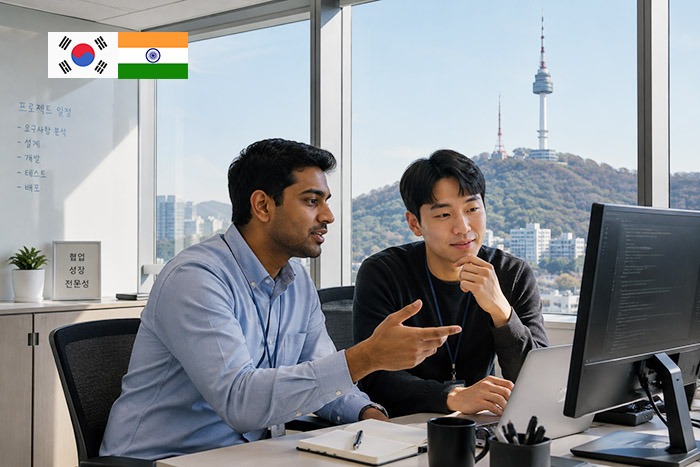
Korea Faces a Growing Talent Shortage
One of the biggest reasons is demographics. Korea has one of the world’s lowest birth rates, and many industries struggle to recruit enough qualified workers.
This problem is especially noticeable in technology, engineering, manufacturing, research, and digital industries. Companies need experienced professionals immediately, and waiting years to develop local talent is often not an option.
As a result, international recruitment has become a practical business strategy rather than an exception.
Indian Engineers Have Built a Strong Global Reputation
Indian professionals have earned an outstanding reputation in software development, information technology, artificial intelligence, cloud computing, cybersecurity, and data science.
Many Korean companies already work closely with international clients in North America, Europe, Southeast Asia, and the Middle East. Hiring employees with global project experience makes communication much easier.
Recruiters often see candidates who have already worked with multinational teams before joining a Korean company.
The Semiconductor Industry Needs More Experts
Semiconductors are one of Korea’s most important industries, and demand for experienced engineers continues to grow.
Indian engineers are increasingly joining companies involved in chip design, embedded systems, electronic engineering, automation, and advanced manufacturing.
Many employers value candidates who already understand international engineering standards and can contribute from the first day.
English Is Becoming More Important in Korean Companies
While Korean remains essential for many positions, English has become the common language in numerous international teams.
Many Indian professionals already work comfortably in English, making communication with overseas clients, suppliers, and headquarters much more efficient.
This is especially valuable for companies expanding beyond the Korean market.
Indian Professionals Often Have Global Experience
Many Indian applicants have previously worked in Singapore, the United States, Canada, Europe, Australia, or the Middle East.
That international experience helps Korean companies build diverse teams capable of understanding different markets and business cultures.
Employers increasingly appreciate people who can adapt quickly to multicultural workplaces.
Technology Is Changing Faster Than Ever
Artificial intelligence, robotics, cloud infrastructure, autonomous vehicles, biotechnology, and digital manufacturing are growing rapidly in Korea.
Companies cannot rely only on traditional hiring methods anymore. They need specialists who already understand emerging technologies.
India produces a large number of graduates in engineering and computer science every year, giving Korean companies access to a deep talent pool.
Manufacturing Also Needs Skilled Foreign Professionals
Many people assume only software engineers move to Korea, but manufacturing tells a different story.
Large factories increasingly hire foreign engineers, quality control specialists, production managers, automation experts, and maintenance professionals.
Indian professionals with industrial experience often find opportunities in automotive, electronics, batteries, chemicals, and precision manufacturing.
Korean Companies Value Problem Solvers
Technical knowledge alone is rarely enough.
Recruiters often look for people who can solve unexpected problems, communicate clearly, work under pressure, and cooperate with colleagues from different backgrounds.
Many Indian professionals have experience working in fast growing industries where adaptability is essential, making them attractive candidates.
Learning Korean Still Creates a Huge Advantage
Some foreigners believe English alone is enough to build a career in Korea.
In reality, learning Korean significantly increases career opportunities. Even intermediate Korean skills can open positions that are unavailable to English only applicants.
Employees who can communicate naturally with Korean coworkers often advance faster into leadership roles.
Understanding Korean Workplace Culture Matters
Foreign professionals who succeed in Korea usually invest time in understanding workplace culture.
Respect for teamwork, punctuality, responsibility, careful communication, and long term relationships remain important in many companies.
Employees who appreciate these cultural differences generally adapt more smoothly and build stronger professional relationships.
The Future Looks Even More International
Korea’s economy continues expanding into AI, renewable energy, robotics, biotechnology, digital healthcare, aerospace, electric vehicles, and advanced manufacturing.
As these industries grow, companies will continue searching for highly qualified professionals from around the world.
Indian engineers, researchers, developers, and business specialists are likely to remain among the most sought after international talent in Korea.
Rather than replacing Korean workers, most Indian professionals fill positions where demand is growing faster than the available domestic workforce. Their technical expertise, international experience, English communication skills, and ability to work across cultures help Korean companies remain competitive in the global economy.
For skilled professionals willing to learn Korean and understand local business culture, Korea offers career opportunities that are becoming broader and more diverse every year.