How Korean Families React to International Marriage
For many foreigners, dating a Korean partner feels exciting at first. Korean culture appears modern, global, and increasingly open-minded from the outside. But once a relationship becomes serious enough to involve family, many international couples suddenly realize something important: in Korea, marriage is rarely viewed as only a relationship between two people. It is often seen as a relationship between two entire families.
That difference changes everything.
South Korea has become much more multicultural over the last twenty years, and international marriages are now common enough that most Koreans personally know someone in a multicultural family. In fact, multicultural marriages in Korea recently reached their highest level since before the pandemic.
Still, family reactions to international marriage can vary enormously depending on generation, education level, region, social background, and personal experience with foreigners. Some Korean families are immediately welcoming. Others become nervous, cautious, or quietly resistant at first. Most reactions fall somewhere in between.

Why Family Approval Still Matters So Much in Korea
One thing many foreigners underestimate is how influential parents remain in Korean adult life. In many Western countries, marriage decisions are viewed primarily as individual choices. In Korea, family approval still carries emotional and social weight, especially regarding marriage.
Parents often worry about practical issues long before emotional ones. They may think about language barriers, future grandchildren, citizenship, religion, cultural differences, financial stability, or how relatives and neighbors might react.
Even highly educated and globally minded Korean parents sometimes feel anxious simply because international marriage still feels unfamiliar to them. This does not necessarily mean they are against foreigners personally. Often, it reflects fear of uncertainty more than hostility.
Older Generations Tend to React Differently
Age plays a huge role in how Korean families respond. Younger Koreans grew up surrounded by global culture, social media, international entertainment, and foreign travel. For many people in their twenties and thirties, multicultural relationships no longer feel unusual.
Older generations, however, grew up in a much more homogeneous Korea. Parents who lived through Korea’s rapid economic development often value social stability very strongly. Marriage traditionally involved shared language, similar family backgrounds, and clear social expectations. International marriage can challenge those assumptions.
This generational gap explains why some Korean parents initially react with shock or concern even when their children themselves feel completely comfortable dating foreigners. Interestingly, attitudes are slowly changing as multicultural families become more visible across Korean society.
The First Family Meeting Can Feel Extremely Important
For many international couples, meeting Korean parents becomes one of the most stressful parts of the relationship. Korean family culture places strong importance on first impressions, politeness, and respect. Foreign partners are often surprised by how formal these meetings can feel compared to casual family introductions in other cultures.
Simple details suddenly matter:
- How respectfully someone speaks
- Whether they understand Korean dining etiquette
- How they greet older relatives
- Their career and education background
- Their long-term plans in Korea
Some foreign partners feel intense pressure to appear “acceptable” to the family immediately. At the same time, many Korean parents are also nervous. They may worry about communication difficulties or whether cultural misunderstandings will create future problems inside the marriage.
Language Barriers Create Emotional Distance
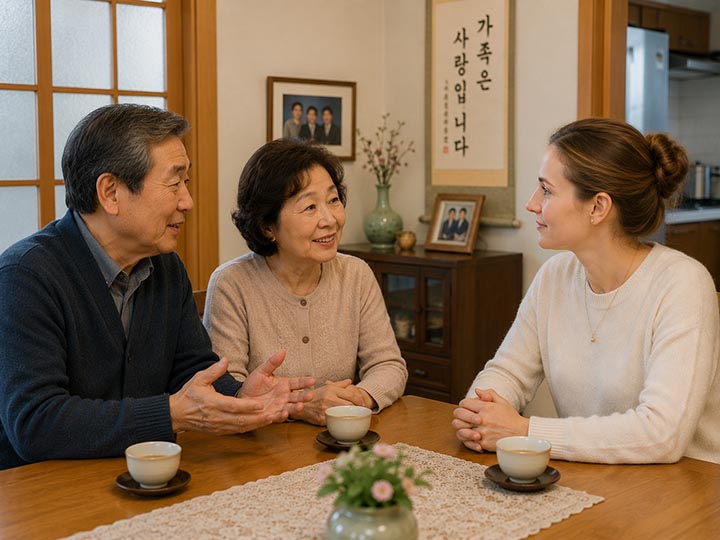
One of the biggest difficulties for multicultural families in Korea is communication itself. Even when everyone is polite and well-intentioned, emotional closeness becomes difficult without a shared language. Foreign spouses often struggle to fully connect with Korean in-laws during conversations, holidays, or family gatherings.
Meanwhile, Korean parents sometimes feel frustrated because they cannot express affection naturally in another language. This communication gap can accidentally create emotional distance on both sides. Many successful multicultural families eventually build their own communication style through patience, basic language learning, humor, and repeated interaction over time.
Rural Families and Urban Families Often React Differently
Location matters more than many foreigners realize. Families living in Seoul or larger cities tend to have more exposure to foreigners and multicultural environments. International marriage in urban areas has become increasingly normalized, especially among younger professionals. In rural regions, reactions can sometimes be more conservative simply because communities remain smaller and more traditional.
Historically, many rural international marriages in Korea involved marriage migration, especially involving women from Southeast Asia or China. Because of that history, some stereotypes still exist in certain regions. However, this is also changing quickly as Korea becomes more internationally connected overall.
Foreign Daughters-in-Law Often Face More Pressure
Gender expectations still influence family reactions significantly. Foreign women marrying Korean men often face stronger expectations regarding family gatherings, childcare, holiday traditions, and relationships with parents-in-law. Some Korean mothers worry whether a foreign daughter-in-law will adapt to Korean family culture or maintain close family relationships after marriage.
At the same time, foreign wives sometimes feel overwhelmed by Korean expectations surrounding holidays like Chuseok or Lunar New Year, where family responsibilities can become intense. This pressure is especially difficult when cultural expectations are never explained directly but are simply assumed.
Many Families Become More Accepting Over Time
One important reality many foreigners eventually notice is this: initial reactions are not always permanent. Some Korean parents who seem uncomfortable at first gradually become very accepting after spending more time with the foreign partner. Once families see stable relationships, responsible behavior, emotional sincerity, and genuine effort to respect Korean culture, attitudes often soften dramatically.
Grandchildren also frequently change family dynamics completely. Many Korean grandparents become deeply attached to multicultural grandchildren and gradually become far more open-minded through personal experience rather than abstract opinions. As multicultural families become more common in schools and neighborhoods, Korean society itself is adapting as well.
Korean Families Also Worry About Their Child Living Abroad
Another issue many foreigners overlook is that Korean parents often fear losing emotional closeness with their child after international marriage. If the couple eventually moves overseas, parents may worry about distance, language barriers with grandchildren, or reduced family connection.
Korean family culture traditionally emphasizes regular contact, family gatherings, and long-term support between generations. International marriage sometimes creates anxiety because families fear those relationships becoming weaker. This emotional concern is often hidden beneath practical questions about jobs, visas, or nationality.
Media and Society Are Slowly Changing Perceptions
Korean television, YouTube, and online media now regularly feature multicultural couples, foreign influencers, and international families living ordinary lives in Korea.
This visibility matters. Younger Koreans increasingly see multicultural families as part of normal modern Korean society rather than something unusual. Even government support programs for multicultural households have expanded significantly during the past decade. Still, Korea remains in transition. Public attitudes continue evolving, but not every family changes at the same speed.
The Reality Is Usually More Nuanced Than Online Stereotypes
Online discussions about Korean families and international marriage are often exaggerated in both directions. Some people claim Korean families are extremely conservative and unwelcoming. Others insist Korea is now completely globalized and fully accepting. Neither view reflects reality accurately.
Most Korean families are complicated in the same way families everywhere are complicated. Some react emotionally. Some worry too much. Some become supportive immediately. Others need time to adjust. But one thing is becoming increasingly clear: multicultural families are no longer rare in Korea. They are becoming a visible and permanent part of modern Korean society.
For many Korean parents, international marriage may still feel unfamiliar at first. But for younger generations growing up in today’s Korea, it increasingly feels like a normal part of the country’s future.