How do Korean students actually study?
The reality of the education system
If you have ever watched Korean dramas or documentaries, you may have noticed something surprising. Korean students always seem to be studying. They study at school, at home, in libraries, and even in cafes late at night.
Many foreigners ask me the same question. Do Korean students really study that much in real life
The short answer is yes, but the full story is a little more complicated. As someone who grew up in Korea and went through the education system myself, I can share what student life actually looks like behind the scenes.
A Typical School Day Is Already Long
For most Korean students, the day starts early. Middle and high school students usually arrive at school around eight in the morning. Classes run throughout the day, usually until four in the afternoon.
During that time, students study many subjects including Korean, mathematics, English, science, and social studies. The classroom environment is quite structured, and teachers move through the curriculum quickly because there is a lot of material to cover.
But what surprises many foreigners is that the school day often does not end when classes are finished.
Private Academies Are a Huge Part of Student Life
After school, many students head to private academies called hagwon. These are after school learning centers where students take additional classes. Some focus on math or English, while others prepare students for important exams.
It is very common for students to attend two or three different academies in the evening. A student might finish school at four, go to a math academy at six, then an English academy at eight.
Because of this schedule, many students do not return home until ten at night or even later. This may sound intense, but it has become a normal part of Korean education culture.
The College Entrance Exam Shapes Everything
One of the biggest reasons for this intense study culture is the university entrance exam. In Korea, the national college entrance exam is extremely important. It plays a major role in determining which universities students can attend.
Many students spend years preparing for this exam. Families often invest a lot of time and money in education because university reputation can influence future career opportunities.
This pressure creates a very competitive academic environment. Students are motivated to work hard, but it can also feel stressful at times.
Self Study Is Also Very Important
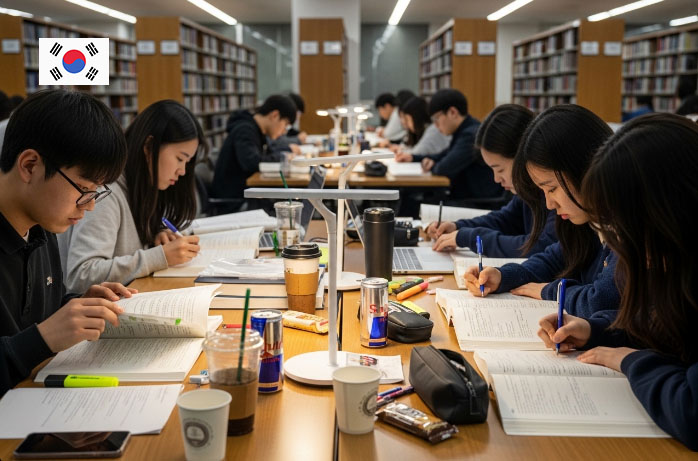
Even after school and academy classes, many students still continue studying on their own. Self study rooms, libraries, and study cafes are very popular places for students.
Some students prefer quiet public libraries, while others like study cafes where they can sit with coffee and focus for several hours. It is not unusual to see high school students studying late into the night, especially during exam seasons.
However, it is also important to understand that not every student studies constantly. Just like anywhere else, students have different personalities and study habits.
Balancing Pressure and Determination
The Korean education system is often described as demanding, and that is partly true. Students face high expectations from schools, families, and society.
At the same time, many Korean students develop strong discipline and time management skills because of this environment. Learning how to focus, organize study schedules, and stay motivated becomes part of everyday life.
Recently, there has also been growing discussion in Korea about improving student well being and reducing academic pressure. Schools and families are slowly exploring ways to create a healthier balance between studying and personal life.
More Than Just Studying
Despite the busy schedules, Korean students still find time to enjoy life. They spend time with friends, watch movies, play games, and follow music or sports.
Friendships formed during school years are often very strong because students go through the same experiences together. Studying late, preparing for exams, and supporting each other creates a unique sense of connection.
So while the study culture in Korea is certainly intense, student life is not only about textbooks and exams. It is also about friendships, dreams, and the hope of building a good future.
If you ever visit a Korean library late at night and see rows of students quietly studying, you will understand something important about Korean culture. Education is taken very seriously here, but behind that seriousness are millions of young people working hard to create opportunities for themselves.