
Two Worlds of Romance: Korean Dating Culture vs. American Dating Culture
If you take a stroll through a trendy neighborhood in New York City or Los Angeles, and then immediately teleport to the hyper-aesthetic streets of Seongsu-dong or Hongdae in Seoul, you will notice a contrast that goes far deeper than just architecture, language, or food.
You will be witnessing two entirely different philosophies on human connection, intimacy, and the unwritten social laws of romance. For years, the global expansion of South Korean entertainment has painted a beautiful, often mesmerizing picture of local love.
However, when Americans actually land on the ground in South Korea and try to apply their homegrown dating playbooks to the local scene, they are almost universally hit by a massive wave of cultural disorientation.
The fundamental disconnect stems from a deeper cultural roots clash. American society is built upon a foundation of fierce individualism, personal independence, and a slow, gradual approach to emotional vulnerability.
South Korea, conversely, remains a beautifully intertwined, fast-paced, and collectivist culture where relationships are treated as a shared public identity and an immediate, all-in team project. Understanding the precise gears that drive these two romantic machines is absolutely essential for anyone looking to bridge the gap between East and West.
From a local expert perspective, looking at these systems side-by-side reveals exactly why the transition can feel so thrilling, yet incredibly complicated.
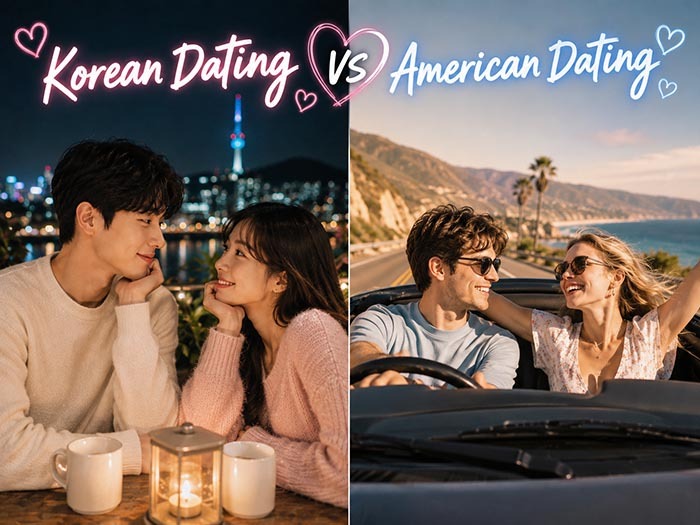
The Early Phase: The Blur of Casual Dating vs. The Absolute Clarity of the Confession
The very definition of what it means to go out with someone is the first major structural divergence you will encounter. In the United States, the early stages of romance are defined by a prolonged, highly deliberate state of ambiguity.
Americans have built a complex linguistic ladder to describe this: you can be talking to someone, hanging out, seeing each other, or casually dating. In this American matrix, it is completely normal, and often expected, that you are chatting with or dating multiple people simultaneously.
Exclusivity is a hard-won prize that only occurs after a highly serious, often anxiety-inducing conversation known as the define the relationship talk, which can happen months into the process.
In South Korea, that entire multi-layered structure is compressed into a rapid, hyper-transparent timeline. The casual, non-committal multi-dating culture of America is largely looked down upon here and can easily be interpreted as a sign of bad character or insincerity.
Koreans use the term ssum to describe the initial spark, a pre-relationship phase where two people show mutual interest but have no formal strings attached. However, the ssum phase is incredibly short-lived, rarely lasting more than a few weeks or three to five high-quality dates.
The transition to a committed relationship does not happen organically through physical proximity over time. It requires a formal event called the gobaek, or confession. This is an explicit, verbal declaration where one person asks the other to officially be their partner.
Once the confession is accepted, you do not slowly ease into things; you are officially exclusive, and the relationship begins at full speed from Day One.
The Communication Baseline: Autonomous Space vs. The Continuous Digital Presence
Perhaps no area causes more genuine friction or culture shock in cross-cultural couples than the daily rhythm of text messaging. For an American, text messaging is predominantly a tool for logistics, setting up plans, or sending occasional witty remarks throughout the day.
American dating advice is famously filled with rules about waiting double the time to reply to an text to avoid looking desperate, and maintaining a healthy amount of radio silence is viewed as a sign of independence and high self-esteem.
In South Korea, if you try to apply that distant American texting strategy, your relationship will be over before the week ends. To a Korean partner, a continuous, seamless loop of digital communication throughout the day is the absolute minimum baseline of respect, emotional safety, and consideration.
It is not viewed as a toxic tool for control or an invasion of personal privacy. Instead, it is treated as a warm, reassuring emotional presence that integrates your partner into your daily life. A typical day involves sending a good morning text, sharing photos of your lunch, updating them when you change locations or finish a work project, and saying goodnight.
If an American disappears for four or five hours without a word because they were busy or just felt like disconnecting, a Korean partner will naturally assume that something is terribly wrong, or that you are actively signaling a complete loss of romantic interest.
The Public Canvas: Individual Boundaries vs. The Aesthetic Partnership
How a couple presents themselves to the outside world highlights another profound philosophical divide between the two cultures. In the United States, even when two people are deeply in love and legally married, they maintain highly distinct visual identities.
Dressing identically or over-commercializing your daily romance can often be viewed by Western peers as cliché, codependent, or slightly embarrassing. American couples value their personal boundaries and often keep their romantic lives relatively separate from their fashion choices or public social media aesthetics.
South Korea takes the exact opposite approach, treating romance as a beautiful team sport that is meant to be celebrated outwardly, proudly, and with immense visual flair. This is the cultural engine behind Korea’s world-famous couple culture.
It is an everyday sight in Seoul to see couples walking hand-in-hand through trendy areas wearing perfectly color-coordinated outfits, identical sneakers, or matching trench coats. This visual synchronization extends to matching smartphone cases, shared couple rings worn long before any marriage proposal, and the meticulous celebration of relationship milestones in hundred-day blocks rather than just annual anniversaries.
For a Korean, publicly displaying your partnership through these shared aesthetics is a profound way of showing security, mutual pride, and absolute devotion to the world.
The Financial Etiquette: The Cold Precision of Splitting vs. The Fluid Rythmn of Rounds
Finally, the way money moves during a date night reveals a lot about how each culture conceptualizes mutual care. In contemporary America, the standard for paying for dates has leaned heavily toward a hyper-individualized model.
It is incredibly common for modern American couples, even those who have been together for a long time, to split the restaurant bill straight down the middle using payment apps, calculating the exact cost of their individual drinks and appetizers down to the cent.
South Korea has a much more fluid, alternating financial protocol based on the concept of rounds, or cha. A classic date night in Seoul rarely stays in one location, it is an evening journey through multiple distinct spots. Round one might be a heavy dinner at a Korean barbecue joint, round two is dessert at an aesthetic cafe, and round three could be a trip to a screen golf zone or a cocktail bar.
The unwritten rule of thumb is that if one partner steps up and pays for the substantial meal in round one, the other partner will naturally take care of round two, and they will continue to alternate or trade off the financial responsibility throughout the night.
This system eliminates the awkwardness of pulling out a calculator or splitting a single piece of paper at the table, turning the financial aspect of dating into an ongoing, fluid exchange of mutual generosity and hospitality.
By shedding the modern Western rules of dating and embracing these rapid, deeply attentive, and highly collaborative relationship dynamics, global travelers can successfully navigate the fascinating landscape of South Korean romance.