
Biggest Dating Mistakes Indians Make in Korea
Dating in South Korea as an expat is an exhilarating ride, but it can also feel like navigating a beautiful, fast-paced maze without a map. With the massive global wave of Korean culture hitting South India, Mumbai, and New Delhi, more young Indians than ever are moving to Seoul for tech jobs, entertainment ventures, or university degrees.
They step off the plane ready for a romance straight out of a K-drama, only to realize that real-world Korean dating operates on a completely different psychological blueprint.
When you come from a culture deeply rooted in grand, slow-burning romantic gestures, extensive family integrations, and certain social dynamics, adjusting to Seoul’s hyper-efficient, highly structured relationship culture takes work. It is not about a lack of mutual attraction, it is about a fundamental mismatch in reading the room.
If you want to build a genuine connection here, you need to understand the cultural blind spots that trip up most well-meaning Indian single expats.
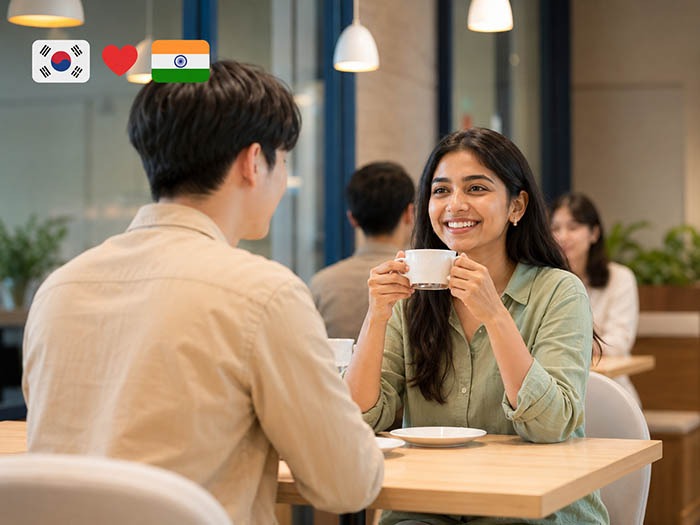
Treating the Relationship and Initial Meetings Like an Interview
One of the most immediate roadblocks occurs during the very first few encounters. In India, checking into someone’s long-term background, career trajectory, academic pedigree, and family values early on is seen as a sign of respect and serious intent. It shows you are not trying to waste their time. In Korea, however, coming on that strong on a first or second date completely kills the vibe.
Young Koreans today live under immense performance pressure in their daily lives, balancing academic intensity and career benchmarks. When they go out on a date, they are looking for an escape from that pressure, not a reminder of it. Asking heavy, analytical questions about their future five-year plan, their family’s social standing, or immediate marriage viewpoints makes the interaction feel like an interrogation.
Local dating culture prioritizes lighthearted chemistry, immediate comfort, and shared experiences over a checklist of credentials. Focus on talking about the food in front of you, a recent movie, or hobbies. Let the deeper details emerge organically later on, or you will find your date suddenly ghosting you on a random Tuesday afternoon.
Misunderstanding the Intense Digital Pacing and Texting Culture
The way couples communicate online in Korea is a massive shock to the system for many expats. In most western and South Asian contexts, if you love someone, you give them space throughout the workday and reply when you are free. A few texts a day with a phone call at night is a perfectly healthy cadence.
Try that in Seoul, and your partner will automatically assume you have lost total interest or are actively hiding something. Korean dating culture relies heavily on constant, real-time micro-updates. It is completely normal to text what you are eating for lunch, a photo of your commute, and a quick note when you enter a building. It is less about deep, philosophical conversations and more about a continuous loop of emotional proximity.
Many Indian men and women mistake this constant digital checking-in for toxic jealousy or over-controlling behavior. In reality, it is simply the default language of affection here. If you are going to be genuinely busy with work or hanging out with friends, you need to communicate that boundary explicitly beforehand. Simply disappearing for five hours without warning creates immediate anxiety and unnecessary friction.
Bringing High-Pressure Conceptions of Family into the Early Stages
In Indian society, family involvement is often interwoven with individual dating lives from an early stage. Discussing your parents, introducing a partner to siblings, or factoring in parental approval is part of showing that a relationship has a real trajectory.
Bring that up too early with a Korean partner, and you will likely trigger a panic response. In South Korea, meeting the parents is traditionally viewed as the final, definitive step before an official marriage commitment. It is an incredibly high-stakes event, even for local couples who have been together for years.
If you start asking to meet their family within the first six months, or if you constantly emphasize how your own family back home must vet the relationship, it introduces an overwhelming amount of pressure. Enjoy the relationship for what it is in the present.
Understand that a Korean partner keeping their dating life private from their parents does not mean they are ashamed of you, it means they are protecting the relationship from premature societal expectations.
Failing to Recognize the Transition from Sshum to Official Exclusivity
The concept of the talking stage has a very specific, structured name in Korea: Sshum. This is the ambiguous, butterfly-inducing phase where two people clearly like each other, hang out frequently, and text constantly, but have not defined the relationship.
The mistake many internationals make is letting this phase drag on indefinitely, assuming that if you are acting like a couple, you are a couple. In many cultures, exclusivity is an unspoken assumption that builds over time. In Korea, you are not officially boyfriend and girlfriend until the explicit verbal confession, known as Gobaek, happens.
Usually, this confession takes place around the third to fifth date, or within the first month of consistent meeting. If you let multiple months pass without explicitly asking them to be your partner, the local individual will assume you are just playing games, looking for a casual situation, or treating them as an experiment. They will quickly detach and move on to someone who is willing to give them structural certainty.
Ignoring the Subtle Importance of Public Presentation and Shared Spaces
Korea is a hyper-visual society where how you present yourself as a collective unit matters significantly. While grand public displays of affection like intense kissing are highly frowned upon and make locals deeply uncomfortable, subtle public synchronization is adored.
This is the birthplace of couple matching outfits, matching phone cases, and celebrating distinct relationship milestones like the hundred-day anniversary. For many expats, these traditions can initially feel overly commercialized, childish, or expensive.
Dismissing these elements as silly or refusing to participate can inadvertently signal to your partner that you are not proud to be seen with them.
You do not need to wear identical head-to-toe outfits, but participating in the small, cute rituals, taking photos together at local photo booths, and leaning into the playful aesthetic of Korean romance shows that you respect their world. It proves you are willing to meet them halfway instead of forcing them to adapt entirely to your cultural defaults.