The Korean Family Tradition That Amazes Americans
When Americans first experience a Korean family gathering, they often notice something that goes beyond the food, hanbok, or traditional ceremonies. It is the visible importance given to generations within the family.
Grandparents, parents, children, and grandchildren can gather around the same table, and age influences everything from greetings to the way people speak. For many foreign visitors, one of the most memorable examples appears during Seollal, Korea’s Lunar New Year.
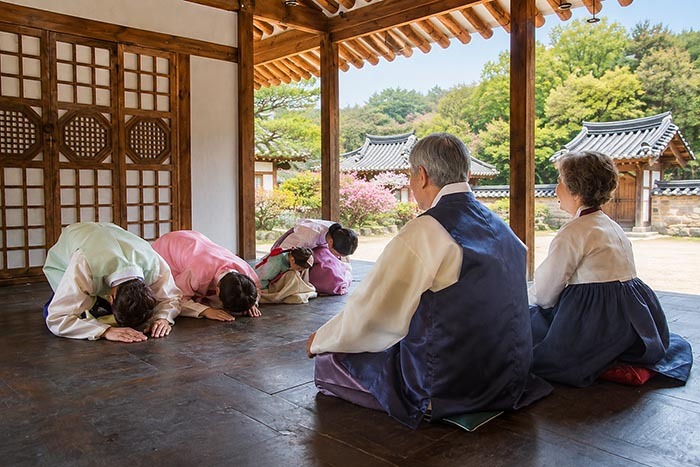
The Deep Bow That Surprises Many Foreigners
On Seollal, younger family members traditionally perform sebae, a deep formal bow to their elders. After receiving the bow, elders give blessings and wishes for the coming year, and children commonly receive sebaetdon, or New Year’s money.
To an American seeing this for the first time, the ceremony can look remarkably formal for a family gathering. In Korea, however, the meaning is much warmer than simply following etiquette. It is a visible way of showing respect and starting the year by recognizing the relationship between generations.
Respect for Age Appears in Everyday Korean Life
The idea behind sebae does not disappear when Seollal ends. Age and seniority have traditionally influenced Korean language, greetings, table manners, and social relationships, although modern Korean families vary greatly in how strictly they follow older customs.
This is one reason foreigners quickly notice Korean honorific language. The way you speak to a grandparent or older relative can be different from the casual language you use with a close friend.
Seollal Brings Families Back Together
One of the strongest parts of Korean holiday culture is returning home to spend time with family. Seollal remains an important period for family reunions, traditional food, greetings, games, and remembrance of ancestors.
For Americans, there are obvious similarities with Thanksgiving and Christmas. The difference is that several distinct Korean customs can take place within the same gathering, creating a strong connection between family, age, ancestry, and the beginning of a new year.

Tteokguk Is More Than New Year’s Food
Food is always central to a Korean family gathering, and Seollal has one dish that almost everyone in Korea recognizes immediately: tteokguk, a soup made with sliced rice cakes.
Eating tteokguk traditionally represents entering the new year and becoming a year older. It is one of those customs that seems simple until you realize how strongly a single dish can connect childhood memories, family gatherings, and Korean identity.
Remembering Ancestors Is Part of Family Tradition
Some Korean families also perform charye, a traditional memorial rite honoring ancestors during major holidays such as Seollal and Chuseok. Food is prepared and family members pay their respects, connecting the present family with previous generations.
Not every Korean family follows these customs in the same way today. Some maintain formal ceremonies, some have simplified them considerably, and others no longer perform them at all. Modern Korea should never be presented as if every household follows one traditional model.
Chuseok Shows Another Side of Korean Family Culture
Chuseok, often compared with Thanksgiving, is another major period for Korean families. Traditionally, relatives gather, share food such as songpyeon, remember ancestors, and in some families visit ancestral graves.
For a foreign spouse or visitor, the experience can be memorable because the holiday connects several generations at once. You are not simply attending a meal. You are seeing how food, family history, hometowns, and respect for previous generations can come together.
Grandparents Can Have a Strong Presence
Many Americans are accustomed to loving and close relationships with grandparents, so family closeness itself is certainly not uniquely Korean. What can feel different is how clearly generational relationships are expressed through language and traditional etiquette.
During holidays, children may bow to grandparents, adults prepare food together, and older relatives share blessings with younger family members. These interactions make the family hierarchy more visible than it may be in a very informal American household.
The Tradition Is Changing
Korean family culture today is not identical to what it was several decades ago. Smaller families, changing gender roles, people living farther from their hometowns, and younger generations with different lifestyles have all influenced traditional gatherings.
Some families still prepare elaborate holiday meals and ceremonies, while others meet at a restaurant or keep the celebration simple. The tradition survives, but its form continues to change with Korean society.
Foreigners Are Usually Not Expected to Know Everything
If you are invited to a Korean family celebration, do not worry about memorizing every rule before arriving. Most families understand that foreign visitors did not grow up with Korean customs and will explain important traditions when necessary.
Showing interest is usually more valuable than trying to perform everything perfectly. Asking what a custom means can also lead to some of the most interesting conversations you will have with a Korean family.
What Americans Often Find Most Interesting
The surprising part is not simply that Korean children bow to their grandparents or that families eat a particular soup on New Year’s Day. It is how many small traditions reinforce the idea that a family extends across generations.
Modern Korean families may express that idea differently from their grandparents, but respect, family connection, and remembering where the family came from remain visible themes during Korea’s biggest traditional holidays.
Final Thoughts
For many Americans, sebae is one of the most visually memorable Korean family traditions. Watching children and younger adults make a formal bow to their elders can initially feel very different from the casual greetings common in many American families.
Once you understand the meaning, however, the tradition feels less formal. It is essentially a way of saying that another year has begun, the family is together again, and the younger generation recognizes the people who came before them.
That combination of respect, family, food, and tradition is one of the reasons experiencing a real Korean family holiday can teach you more about Korea than simply visiting another tourist attraction.