A Guide to Korean Temple Etiquette
If you are traveling through South Korea, a visit to a Buddhist temple is likely at the top of your list. Whether it is the cliffside beauty of Haedong Yonggungsa in Busan or the ancient forest vibes of Bulguksa in Gyeongju, these temples are the spiritual heartbeat of the country.
But here is the thing: these aren’t just “tourist attractions” or museums. They are active living spaces for monks, nuns, and practitioners.
As a local expert who has seen many well-meaning travelers accidentally stumble into awkward situations, I want to give you the “native” perspective on how to navigate these sacred grounds. It is not about being perfect; it is about showing Jin-sim sincerity. Here is how to keep the peace and stay respectful.
The Dress Code: Modesty Over Fashion
Seoul might be a global fashion capital, but the temple is the one place where your “Y3K” futuristic streetwear needs to take a back seat. The rule of thumb here is simple: cover your shoulders and your knees.
Even if it is a blistering 30°C in August, wearing sleeveless tops or short shorts is considered quite disrespectful. Many temples are now located in national parks where “Gorpcore” (hiking fashion) is the norm, which is perfectly fine.
Just make sure your outfit doesn’t scream “beach day.” Also, remember that you will be taking your shoes off frequently to enter the prayer halls. Wearing clean, hole-free socks is a small detail that speaks volumes about your manners.
The Hapjang Bow: The Universal Language of Respect
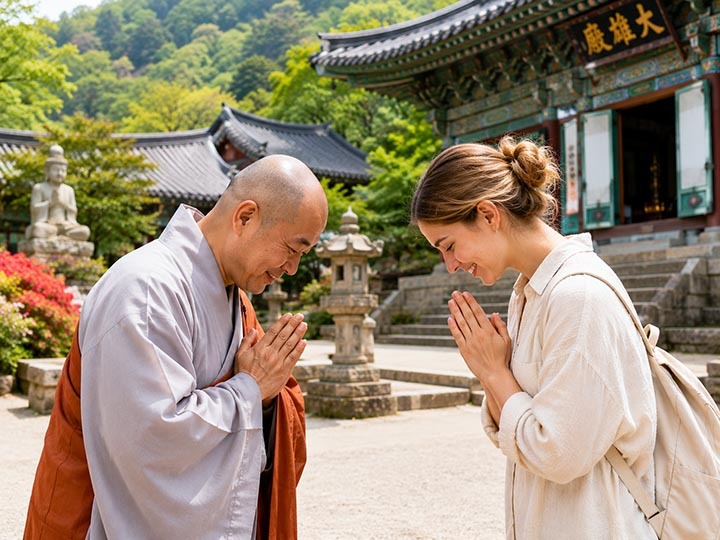
When you see a monk or a nun, you don’t need to say “Hello” in a loud voice. Instead, use the Hapjang. This is the traditional Buddhist greeting where you place your palms together in front of your chest and give a slight bow.
This simple gesture is like a secret handshake that tells the temple residents, “I respect your space and your practice.” You can also use this when you enter a prayer hall or as a silent “thank you.”
In a world of digital noise, there is something incredibly powerful about this silent, physical form of communication.
Entering the Hall: Mind Your Feet
When you walk into a main hall (the Daeungjeon), look at the floor. You will see a central path leading directly to the Buddha statue. Do not walk down the center. That path is traditionally reserved for monks. Instead, enter through the side doors (left or right) and walk along the sides of the room.
And here is a big one: never step directly on the wooden threshold (Mun-teok) of the doorway. In Korean tradition, stepping on the threshold is said to bring bad luck, but in a temple context, it is simply seen as rude. Always step over it. It might seem like a small thing, but the locals will definitely notice and appreciate that you know the rule.

Photography: Knowing When to Put the Phone Away
We get it Korean temples are incredibly “Instagrammable” with their Dancheong (traditional multi-colored paint) and serene landscapes. Taking photos of the temple grounds and the exterior of buildings is generally fine.
However, never take photos inside the prayer halls, especially if people are meditating or prostrating. In 2026, many temples have strictly banned “reels” or loud filming inside to maintain the sanctity of the space.
If you see a sign that says “No Photography,” please respect it. The most beautiful part of a temple visit is the feeling, not the digital file.
The Sound of Silence: Managing Your Volume
Temples are “Quiet Zones.” Even if you are with a group of friends, keep your voices to a whisper. This extends to your digital life as well switch your phone to silent mode before you even pass through the first gate (Iljumun).
If you happen to be there during a ceremony when the monks are chanting or striking the large bell, find a spot to sit or stand quietly at the back. Don’t try to push to the front for a better view. Being a “silent observer” is the highest form of etiquette you can offer.
Final Thoughts: The “Chasu” Walk
If you really want to look like a pro, try the Chasu position while walking. Simply place your right hand over your left hand at the level of your lower abdomen. This is the traditional way to walk within temple grounds. It keeps your hands from swinging wildly and naturally slows your pace.
A temple visit is a chance to slow down in a world that is moving too fast. By following these simple rules, you aren’t just being a “good tourist” you are becoming part of the serenity itself.