
No-Grease Sunscreen: The Ultimate Guide for Filipina Skin
Living in a climate where the humidity hits you like a warm, wet blanket the second you step outside means your relationship with skincare is complicated. For years, the global beauty industry told everyone that a healthy glow was the ultimate goal.
But let us be honest about what a healthy glow actually looks like when you are walking down a street in Manila or commuting in high humidity. It does not look like a morning dew. It looks like a layer of cooking oil. This is the exact reason why so many people with Filipina skin secretly or openly hate wearing sunscreen.
The traditional formulas available on the market are often heavy, thick, and designed for western climates where the air is dry and the skin needs heavy emollients. When you apply those thick creams onto oil-prone skin in a tropical environment, your pores choke.
Within an hour, your face becomes a magnet for dust, your makeup slides down to your chin, and by the end of the week, you are dealing with a fresh breakout of stubborn acne. But skipping sunscreen is not an option when the tropical sun is actively causing hyperpigmentation and darkening acne scars. The challenge is finding a formula that protects without transforming your face into a frying pan.
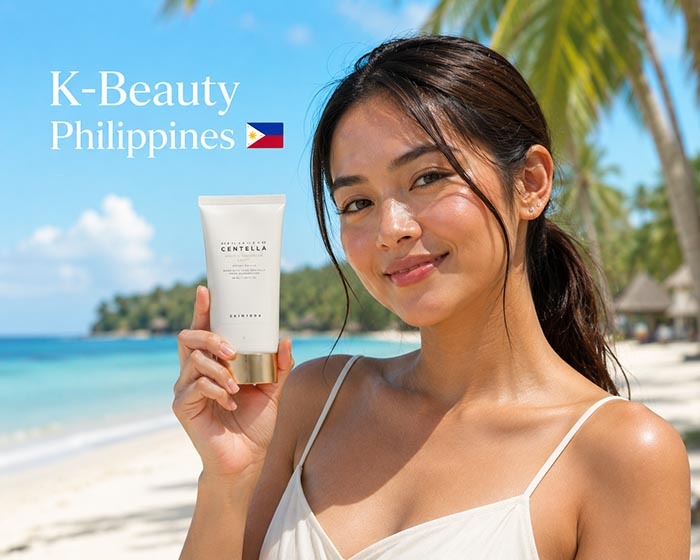
Why Korean Sunscreen Engineering Changed the Game
This is where the shift toward Korean skincare completely changed how we view sun protection. In Korea, the approach to creating sunscreen is entirely different from the traditional western methodology.
Korean laboratories treat sunscreens as lightweight hydration steps rather than heavy protective shields. They utilize advanced UV filters that are legally approved and widely available across Asia and Europe, which allows the formulas to remain incredibly fluid and thin.
Instead of relying on heavy oils to suspend the sun-blocking ingredients, Korean formulations use water-gel bases and spherical powder technologies. These micro-particles are designed to sit invisibly on the skin surface, absorbing excess sebum as it rises from your pores throughout the day.
When you apply a modern Korean sun gel, it feels exactly like a splash of water or a light splash of aloe vera. It sinks into the skin within thirty seconds, leaving absolutely no sticky residue behind. For brown skin, the benefits go even deeper.
The Endless Battle Against the White Cast
For anyone with a beautiful olive or deep brown skin tone, the phrase zinc oxide often brings back traumatic memories of looking like a ghost in family photos. Traditional physical sunscreens rely on minerals that sit on top of the skin to reflect UV rays. While this is great for sensitive skin, it creates a chalky, purple tint on richer skin tones that no amount of blending can fix.
The newest generation of Korean chemical sunscreens solves this completely. Because they use photostable organic filters, the liquid goes on completely transparent.
You can apply the full recommended amount, which is about two finger lengths for your face and neck, and the product disappears into your skin without changing your natural skin tone. You get the highest level of protection, which is rated at SPF 50+ and PA++++, without looking like you are wearing a chalk mask.
How to Choose the Right Texture for High Humidity
When you are browsing through options, you need to understand the terminology used on the packaging to find the perfect match for your skin needs. If your skin is exceptionally oily and you notice a shine on your forehead before lunch, look for terms like sun milk, sun essence, or sebum-control. These formulas usually contain silica or green tea extracts that actively regulate oil production while providing a satin or semi-matte finish.
If your skin is combination, meaning your cheeks feel tight but your T-zone is oily, a sun gel or a watery sun cream is your best option. These products provide deep hydration using ingredients like hyaluronic acid or centella asiatica, which calms skin irritation caused by intense heat exposure. They balance the skin moisture levels so your face does not feel the need to overproduce oil to compensate for dehydration.
The Golden Rules of Application and Reapplication
Finding the perfect product is only half the battle. How you apply it in a hot climate determines whether it stays on your face or melts off. Always apply your sunscreen as the final step of your morning skincare routine, at least fifteen minutes before you step out into the sun. If you wear makeup, give the sunscreen a solid three minutes to set and form a protective film before applying your cushion or foundation.
Reapplication is where most people fail because patting a liquid cream over a face full of makeup and sweat sounds disgusting. For mid-day touch-ups, the beauty industry introduced sun sticks and sun cushions.
A quick swipe of a matte-finish sun stick over your skin absorbs the midday oil while instantly renewing your UV defense. It acts like a blotting paper and a sunscreen combined into one portable tool. By making this switch, you can keep your skin protected, clear, and perfectly matte, no matter how high the humidity climbs.